
Tributary Paradigm
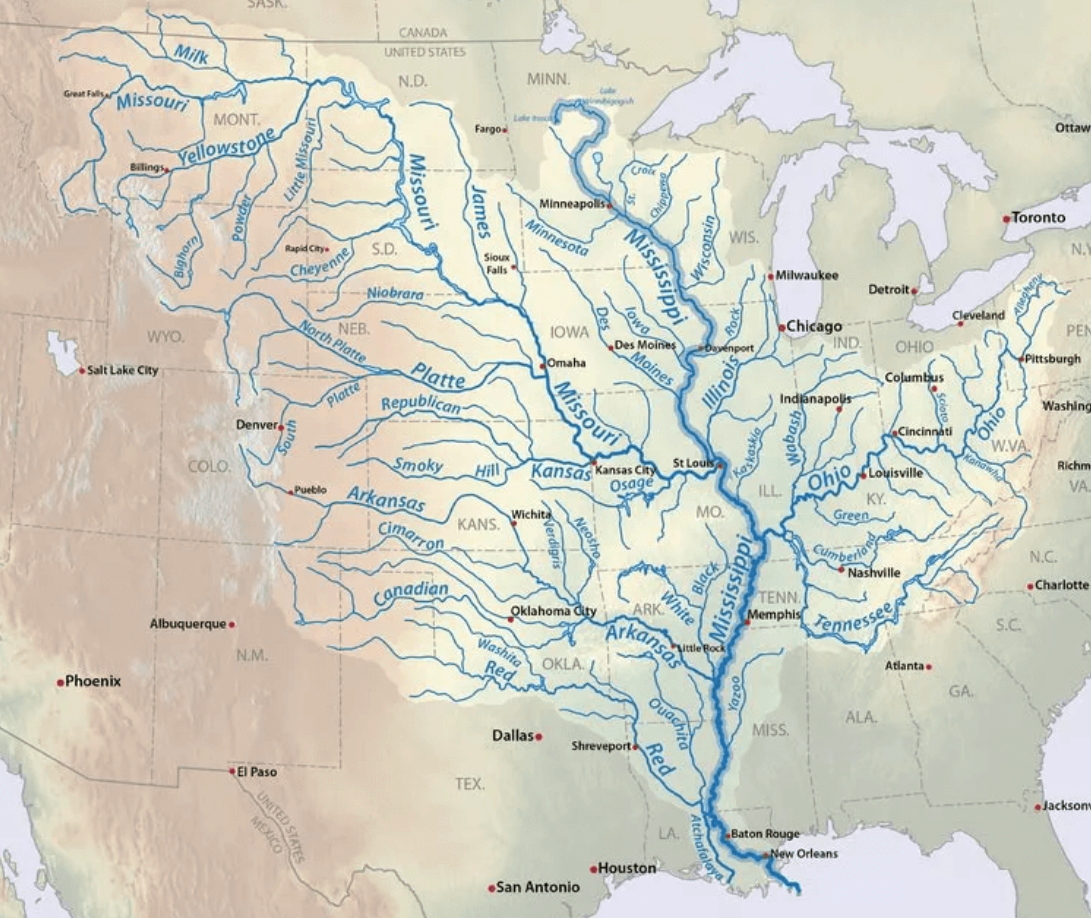
This is the first of at least 3 articles intended to help non-technical folks understand the concepts and limitations of the data mesh paradigm.
Most data pros understand that business data exists in an ecosystem. However, the scale and sprawl of any given enterprise's valued data can mask that perspective and feel overwhelming - especially to your business stakeholders trying to make sense of it all.
In this paradigm, I liken the data ecosystem to the Mississippi River Basin. Water flowing through this system is a raw, valuable asset produced as an outcome of nature. Water, as a local byproduct of the weather-making process, has inherent value. It keeps humans, livestock, and food crops alive. Beyond these most basic uses, it can also be harnessed to produce power, provide flood control, enable sanitation, and promote recreation.
The Local View
If you own land, you also own the water nature provides. You can water your livestock, irrigate your crops, and dig wells for drinking, bathing, cooking, etc., assuming Mother Nature provides sufficient rainfall or tributary topography on your land.
However, not everyone owns enough land or has the resources to provide for their own water needs, nor is it pragmatic for everyone to manage the full spectrum of water management activities. In order to support public safety and welfare, infrastructure and governance are required. In other words, there are limits on how you can use the water on your land - especially if there are waterways where removing or affecting water flowing through your land affects those downstream.
The key principle here is that the individual or smaller communities don't always have the insight, resources, or concern for public interests to unilaterally manage their own water assets. Infrastructure, governance, and effective distribution mechanisms are required to ensure the assets benefit everyone, hopefully without undue hardship on the landowner.
It's the same with data, even when applied in a mesh paradigm. Ownership of raw data assets doesn't imply full discretion to alter, transform, aggregate, or create custom calculations in a vacuum or functional silo. Much like the owner of land containing springs, creeks, streams, and rivers, the owner of data assets MUST submit to the needs and concerns of those downstream of what they do with "their" data.
Unlike many with data governance expertise, I won't shy away from using the "O" word. Ownership of raw assets within the overall data ecosystem should be constrained in much the same way as riparian rights are for landowners by well-established legal and public welfare precedents.